Friday, July 27, 2007

Eager to leave

RR journal - June 24, Still Kolkata

Kolkata-Behrampore
16km-231km (mileage reading)


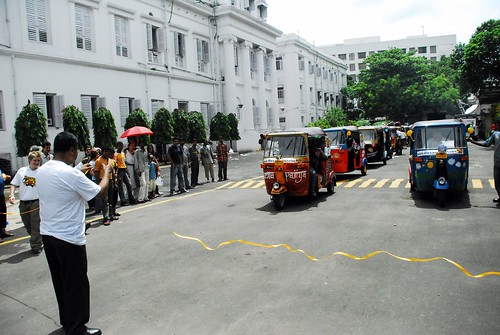
The flag-off is at noon and we’re upset about that. We would have liked to leave early in the morning and covered as much as distance as we could before it got too hot. Instead, our first journey with Saira will begin in searing heat. But even that can’t keep our spirits low for long. We tuck all our things into Saira, fitting them as best as we could. We knew we’d get better at this (and we have). The rest of the morning is spent chatting with the teams and recording audio and exchanging boasts. Our team is a big favourite with all the newspapers and television channels. They all want to know more about the only Indian team participating in the event. I try to fade to the background a bit, being from a media organisation and all that, but my size makes that difficult, I realised.
DSC_0459

Akshay and Shez decide that the journey should start with me behind the wheel. It’s quite an honour and means a lot to me. I think they could tell by the manic smile I wore the rest of the day till we left. At the flag-off, we were in the lead and I was super glad that we didn’t stall, like many of the teams did. Tom’s words from two nights before were at the back of my mind: “Most of the accidents happen in the first ten minutes, even before the journey has fully started.” And that did happen with a lot of people. But our Saira was a star; she purred blissfully and kept us in the lead behind the traffic marshall who was leading us out of the city. The going out of the city was good, especially with Kolkata’s autorickshaw drivers giving us a resounding applause when our convoy stopped for fuel and they saw we were up to.
But before we were too far out of the city, we realised that three teams that were planning to take the India route to Manali (as opposed to going through Nepal like us) were travelling in the wrong direction. We flagged them down, and set them on the right track. That was our first rescue. Just a little later we ran into Barnaby and Jamie, the Orient Express. They were already having a spot of trouble with their rickshaws and had discovered that they were out of cash and their ATM cards weren’t working. We spotted them some money and helped them along their way, our second rescue. We didn’t know then that this would be the trend for most of the journey.
Once we escaped the city traffic, our drive was beautiful and our spirits were high. We all drove Saira for a bit and we reached Krishnanagar by six in the evening. We decided to go on to Behrampore, which in hindsight was not a very smart decision, since we ended up driving in the night for a bit. But, as darkness descended, we ran into more autos (Andy was having trouble with his rickshaw and we found the convoy of three he was part of by the side of the road. After some driving tips, we were back on the road) and we travelled through the night in a bright little caravan. In Behrampore, we found the same hotel where some of the teams had reached before us, and dinner was a lively affair, with everyone comparing notes on their first day of driving a rickshaw and the size of the blisters on their left hands, which they use to change gears.

cross posted on teesra

Thursday, July 26, 2007

Hello Saira

RR Journal - June 23, Kolkata

When we reach La Matiniere at 10am, the first four autorickshaws have already been taken and we have to wait for the next lot. They were all supposed to have reached by 7am, but the organisers just tell us, “This is India, you guys know better than us how things work here.”
When the next four rickshaws arrive, Shez and Akshay are off wandering, one examining the handiwork of the others, the other taking photos. So it’s up to me to grab a rickshaw for us and I choose the one with the nicest license plate number – 4114.
The rickshaws are 175cc, 4-stroke machines with self-starters. That’s 28ccs more than the 147 we expected – which makes us very grateful – when you’re planning to go the Himalayas in an autorickshaw, an extra 28ccs tend to have that effect.
There’s a guy at hand with a team of painters and mechanics who can soup up our rickshaws with whatever extras we need. We opt for a dog horn, extra headlight and a stereo, plus a raincoat to cover the sides of the rickshaw when it’s wet. We consider asking the painters to paint it for us, but the price is too high, even with our ‘Indian’ discount, and we decide painting it ourselves will be more personal. So we head off to buy the paint.
Just before we left, Tom decided to give everyone a tutorial on how to drive the rickshaws in our Saira (that’s what Shez named her by then) and another auto. He took the keys to Saira, and gave me another set and told me to give it a whirl. Thanks to the little training I’d had with Faisal back in Mumbai, driving the rickshaw wasn’t hard and I was soon giving some of the students of La Martiniere a joyride around the compound. Once everyone had given the rickshaw a whirl, we were ready to go. We were also beginning to get worried about everyone learning to drive on Saira and stalling her every five seconds, so we stole the keys away from Tom and went off to buy paint.

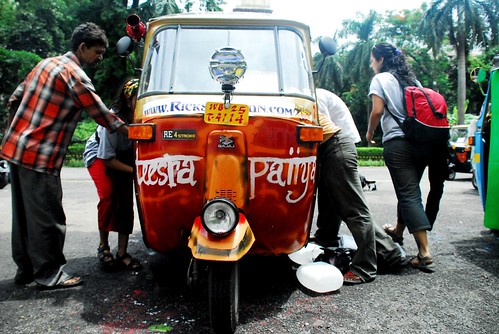
Teesra Pahiya at Launch

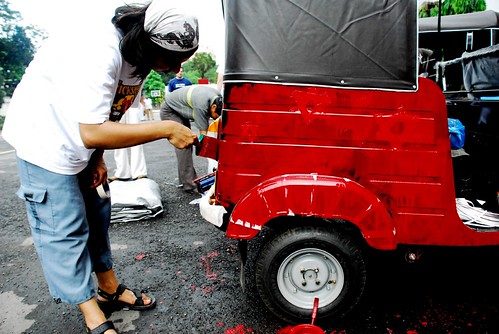
The rest of the day went by in a whirlwind. At some point Akshay and I disappeared to run various errands and Shez was stuck till late in the night, painting Saira. As you can see, she did a good job. At night we went for the kick-off party, but we were all pretty exhausted and decided to turn in early, so we could be well rested before beginning our journey.

cross posted on teesra

The secret to sleeping well

I’ve been a grouch since I came back. A bit lethargic, a bit of a recluse. The city makes me claustrophobic and I can’t handle the company of more than one or two people at a time. A learned friend put it down to a nature versus city life syndrome. I think it’s something he made up to appease me, but it’s still accurate. Because somewhere at the back of my head, I’m yearning to have the open road ahead in front of me again; longing for the expanse of green paddy fields and the majesty of the Himalayas and the surprises that each turn in the road brings.

When we set out on our trip, we had only the roughest idea of where we were going. Despite excellent advice from many quarters, we had not planned what roads we would take and where we would stop every night. We wanted to play it by ear, go where instinct would take us, stay where fancy decided to stop and take a look. All we knew for sure was that in 14 days we had to be in Manali, so we should be travelling roughly 250km a day, if we took the straightest road. If we wandered, we’d have to make up for it.

We had maps, but they were largely useless. They gave us a sense of direction, but what looked like a biggish town on paper, inevitably turned out to be a significant crossroad or a truckers’ stop. The towns that actually had places to stay were often not even mentioned. So, people were our most reliable source of information. And getting that information was my job; because I knew the language best (I’m also the journo, asking questions is my ‘thing’).

So each morning, while everyone was getting ready to leave, I would sneak out for a bit in search of our next destination. Hotel receptionists, shop owners, truck drivers were all quizzed. Often I had to face a barrage of cross-questioning before I got any information. Was I Indian? Why was I travelling in a red autorickshaw? Did I drive it myself? Does it run on petrol? What is the average? Who had come with me?
In return I had my own litany of questions… what is the next best place to stop? At 200km? And if we reached there early enough and wanted to go on, then at around 300 km? Any places along the route that were must see? Even if we had to take a diversion? After all, we didn’t mind meandering. Driving straight from one point to another seemed ridiculous, I wanted to explore every little lane that caught my fancy, but maybe they could tell us which ones were really worth seeing?

And that’s how it was every day. All that was important was the road ahead of us and the sights along the way. Not knowing was liberating. If we reached a town and it was getting dark, we stayed. If we had enough light, we carried on. All we had to do was find a bed at night.

And we always did. Though the conditions varied. Some times there was air conditioning; sometimes, just a sluggish table fan. Sometimes the flush didn’t work; other times there was hot water and we felt like royalty. At Chitwan, there was no one else and we got a big discount. At Attari, a town at a crossroad, the only guesthouse was full and we paid a high price for a dorm with a common (very dirty) loo (no one had a bath that day).

When we had the luxuries, we enjoyed them. But even when we didn’t, just having a place to sleep was enough. By night, so full were we of the day’s experiences that nothing else really seemed to matter. And we always slept well, knowing that in the morning we would feel the pull of the road again.

cross posted from teesra

Molten memories

With time, her memories have become like yellowed pages curling in on the edges. Here and there words are smudged, and phrases are lost. Like she doesn’t remember the words M used to shriek down the phone line every afternoon, the moment she got home from school. She remembers the high-pitched tone, the lilt of her voice, the way the words rushed together to become one word. But the words themselves are lost.
She strains to remember them. Trying different permutations and combinations of words that fit the tone. Different words that say the same thing. She says them at varying speeds, in different accents. Shuffles them back and forth. But no matter how hard she tries, she can’t seem to find that phrase that the phone would shout back at her every afternoon of the torrid Delhi summer. But the tone is stuck in her head, playing on endless repeat.
At the time, she thought those memories had become frozen in her mind. Like the images on that last reel of photographs of them together, taken on that warm afternoon spent at A’s house. The one she’d exposed by mistake while fiddling with the camera. Memories permanently frozen on an exposed film reel; never to see the light of the dark room, never developed.
Now, she wishes she could make her memory whole again. Pick up the phone and dial the number that she, oddly, still remembers and hear M gush those words at her. Then maybe the endless repeat would end; the way you just have to hear a song once it’s stuck in your head to make it go away. She wishes it were as easy as that. Hitting play on the cassette player and satisfying the craving. But she’s afraid all she will hear is the silence at the end of a song.

Team of four

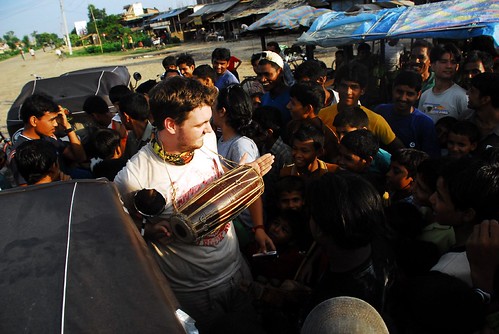
When I drive Saira Bano (our autorickshaw) I feel like a rockstar. Children wave and run after our rickshaw. Old people give us gap-toothed smiles. Women look up from their washing. Men’s mouths fall open to see a girl driving a three-wheeler. When we stop at a town, we’re swamped by onlookers, like any Bollywood star would be. Surveying the road from behind my semi-circular windshield, my hands resting on the handlebars, I listen to Saira’s purring, and feel content, almost deliriously happy.

postk 118

Shez named Saira after sitting inside her for 10 minutes. She said the rickshaw “spoke” the name to her. I pulled her leg about it a little, but Akshay and I quite liked the name, so we decided to go with it. I knew that for me Saira was just a name, it would only acquire characteristics later, as I got to know her quirks. I’d simply chosen her on the basis of her license plate number, the symmetry of 4114 appealed to me.
In the beginning, driving her was quite painful; I could feel the blisters rush up to the skin in my left hand, which I used for the clutch and to change the gears. Also, for the first 1000km we couldn’t push her to full throttle and had to follow Bajaj’s directions about top speeds at different gears. That made things quite difficult, and we stalled a number of time, until we realised that instead of trying to follow written instructions to the letter, all we had to do was to listen to Saira. Her engine would tell us when we needed to change gears and just how far we could push her. Learning to listen is perhaps the most important thing Saira taught us.
The other was patience. Whenever we tried pushing her to higher speeds before she was broken in, the engine sputtered and died. Or if we tried starting her too suddenly, or didn’t warm her up long enough in the morning. We learnt that we must take regular breaks, because even if we’re not tired, our hardworking little rickshaw needs time to cool down. That if she stalls in the middle of traffic then instead of panicking, we must make our movements measured and purposeful.

paintrick 171

She’s a great little vehicle to travel and see new places in. You definitely can’t complain about the size of the ‘windows’, plus she wins us friends and goodwill wherever we go. I may have done a shoddy job with her base coat (which Shez and some painters covered up rather well) but she’s a bright bubbly creature who makes everyone want to smile at us and curiously ask where we’re going and what we’re doing with her.

postk 153

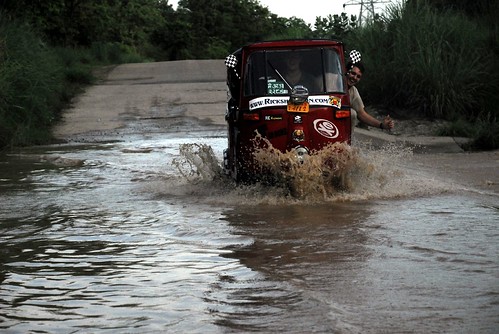
We’ve crossed many a hurdle with trusty Saira. In fact, Nepal was an obstacle course of sorts. When it wasn’t natural obstacles – rivers flowing across the road, a bridge collapsed like a pack of dominoes, steep and curving mountain roads – it was manmade ones. In the Eastern Terai, the Maoists had set up roadblocks everywhere using whatever was handy. Fallen trees, stones from bridge bulwarks, truck tyres. In many places we crossed the charred remains of buses and vehicles they’d burnt, and round burn marks on roads where tyres had been burnt. The Western end of the highway was no better, suffering from general lawlessness. In one place, once I persuaded the protestors to let us cross their roadblock, Shez had to negotiate little Saira past flames that were as high and bright as her. There, fuel also became increasingly difficult to get. At one point, we’d used up all our fuel, included the extra five litres we carried in our jerry can, and our reserve was about to run our when we found a man by the side of the road selling petrol.
Since he knew our need was desperate (every single pump we’d passed over the last 220km had been dry), he sold the fuel to us at a 30 per cent markup, but we got ourselves enough to get us out of Nepal.
Driving through the mountains was another experience all together. When we first hit the steep winding roads, I was behind the wheel (handlebar?). I drove surely and carefully, and later when I asked Shez and Akshay they told me they did not feel unsafe at any point. But throughout that journey a voice in my head kept screaming that I was a horrible driver and I would not only crash Saira and myself, but endanger Akshay and Shez as well. The two of them say that it is perhaps this voice that makes me a good driver. But as I grew more comfortable, I began to love the way a new vista would open up before us, each time we took a sharp curve. I even enjoyed the surreal feel of a bit of night driving that we did on our way to Kathmandu, when all I could see was a solid block of shadow to my left (the mountain) and only five feet of road was illuminated at a time by Saira’s little headlight.

postk 165

On the road, we drove past all kinds of creatures as well. The suicidal dogs of West Bengal, which would do their best to come in our way; the cows and buffaloes of the Eastern Terai; and the fireflies and frogs that took over the highway in the evening in the western part of Nepal. What I liked best were the hordes of yellow and green butterflies that would scatter in our way as we drove past, some of them hurtling towards the windscreen in a fatal trajectory only to pull up the last minute and float lightly past.
We left Kolkata as a three-member team, but now as we get ready to make our way up the hills to Manali, we’re a team of four that will be giving it everything we’ve got.

cross posted from teesra

To pack a bag is no easy thing

One of the most important things when we were getting ready for this trip was to pack light. Everyone was allowed one medium-sized bag to fit all their worldly possessions it – or whatever they needed for a week on the road.
The clothes alone posed a problem. We’d be travelling through varying terrain: the rickshaw run would throw everything India and Nepal had in our face – sweltering heat, lashing rain and the cold of the Himalayas. I started with taking things out of the cupboard and piling them on the bed, choosing very, very carefully. The t-shirts had to be strong and worn in; the pants sturdy but light, so they would dry easily. A raincoat. Warm clothes. Maybe a vest to add layers if it gets cold. No point taking anything pretty, even for the starting and end party, it’ll just be a waste of space.
Even so I ended up with two tallish piles. But after two rounds of whittling down, they were reduced to the barest minimum. Five t-shirts, two trousers, one pair of shorts. A sweater and a windcheater that could double as rain protection. Five sets of undergarments, four pairs of socks, two of them warm. One towel. This included the clothes I’d be wearing. For the rest, I would have to wash and reuse. When I couldn’t wash, I could give an old t-shirt away and buy a new one.
Toiletries? Shampoo, check. Conditioner, waste of space, live without it. Facewash, errrm…okay, but double it as soap, so you have to carry one thing less. Toothpaste and brush. Spare spectacles, notepad, passport, medicine kit, comb, recorder, laptop and charger. Shall I take something to read? Tempting, but no, it would be space consuming, just look out when you’re bored, there’ll be plenty of new things to see.
Shez is a regular boy scout. She rolled everything she needed into the smallest size possible and fit it into a small backpack. Then she surveyed my pile of clothes like a schoolmistress, okaying things as I showed them to her one by one, and making me remove some. The next morning when Akshay showed up with a bag half his size and two cameras, we almost attacked him.
Since then, we’ve been roughing it out. Washing clothes when we get a chance, drying them where we can. Back of chairs, window sills, curtain rods, balconies when we have the luxury of one, and even on a string stretched across the rickshaw (which won us many laughs, and almost lost me a t-shirt). Akshay is a bit lazy in these matters, so he prefers to buy t-shirts. Now his bag has expanded to the point that Shez and I are planning to bully him into giving some clothes away.
But with each passing day, our packing has become more efficient. Shez is the expert, and I beam with schoolgirl joy when she looks at my bag approvingly, and praises its increasing compactness. Each day we find a better way to sling our jerry can of extra fuel or fit our bags into the back of our tiny rickshaw efficiently. We know what is the best way to pack out things so that everything can be neatly out of sight, yet the medicine kit, the pen knife, the toollkit, the jackets and our papers are easily accessible when we need them. For that, we consider ourselves minor heroes.

Cross posted from teesra

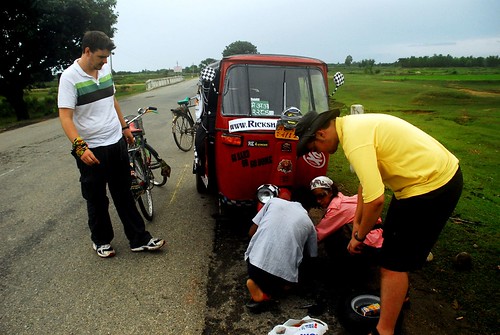
Gathering a crowd 101

How to gather a huge crowd on an empty desolate highway.
Or
How to have fun changing a tyre


Take two three-wheeled rickshaws. Paint them red.
In one, put three crazy Indians.
In the other put two 21-year-old British chemical engineers, Chris and Owen, who look really sensible (note to self: looks can be deceptive)
Have a flat tyre in the middle of an absolutely empty road, when the only person you can see in the distance is a shepherd girl with her six goats.
Have an incredible amount of fun changing the tyre.
For starters, discover the fact that you never thought about the possibility of needing a jack.
Look for alternatives. Find one large stone, one smaller, flattish stone.
Find one local who is walking by, stops out of curiousity, speaks a mix of broken Hindi and English, has one, very brightly pink nail, and is good at shoving stones under the front end of rickshaws.
Lift rickshaw. Takes me, Owen, Chris and Akshay to do that. Takes all my energy. Ask Shaizia and pink-nailed local to prop up rickshaw with the two stones pile on one another.
Try not to drop rickshaw, also, try not to let it slide back on its rear wheels. Stones have to be re-adjusted and you have to hold the rickshaw up longer.
By this time, everyone who has used this road in the last twenty minutes is gathered around you. Field questions about who you are and what you’re doing in bright red rickshaws in the middle of Nepal. Drains all remaining energy.
Wander in the field while the boys change the tyre. Jump across stream. Skip stones. Find one smooth round very white one. Eat some chocolate. Chase some goats.
Return fully refreshed to lift rickshaw again, this time to remove the stones. Bow when everyone gathered around cheers and claps when you’re finally done. Wave like a film star. Blow some kisses. Leave. Try not to stall. Cramps style.

Eastern Terai -  - HT -5

Changing a tyre has never been so much fun. Rolling green paddy fields as far as you can see on one side. In the other, faint hills framed against a bright blue sky with powder puff clouds. A gentle breeze, lots of energy and some good cheer. It was more like a fun thing to do together than a problem.
In fact, whatever auto trouble we’ve had on this trip has been fun or led to some good. When our clutch wire got lose on the second day and we lost two hours finding someone who could fix it (the first guy we found actually made it worse), the boys caught up with us. Earlier, some of the teams had passed us without bothering to pause (that really annoyed me; we’d stopped for them a little earlier and offered help when they had a flat), but Chris and Owen stopped to ask if we needed help.
Running into them was one of the best things that happened. They are always in good spirits, even when they’re incredibly tired. They’re willing to wake early and hit the road so we can drive longer. Ready to slug it out and go the distance, if we have to make up for lost time. Just like us, they like making pitstops in the middle of nowhere for some chai and scenery. They’re ready to change the plan and stay in an out of the way place so we can see some more of the country we’re travelling through instead of just speeding through from point to point.
In fact, they’ve redeemed the British folk who didn’t stop when we were in trouble. And together we’ve found out: trouble can be fun.

Cross posted from teesra